




What does a car seller want? A quick cash deal at the best market price without getting scammed and with zero legal liabilities post-sale, right?
But the used car market is not that simple to navigate. That’s why we have compiled this simple 2026 guide to sell your car online safely, with cautions and some lesser-known tips and tricks.
What does selling your car online mean?
Selling your car online in Australia refers to three distinct digital paths. First is the Marketplace model (DIY), where you list the car on relevant platforms. Second is the Instant Offer model (direct sale), where a company buys your car directly via their website.
The third is the Dealer-Bidding model (managed auction), which acts as a digital broker, putting your car in front of a professional network. Hundreds of licensed dealers bid against each other to buy your car.
How to sell your car online in Australia? (Step-by-step)
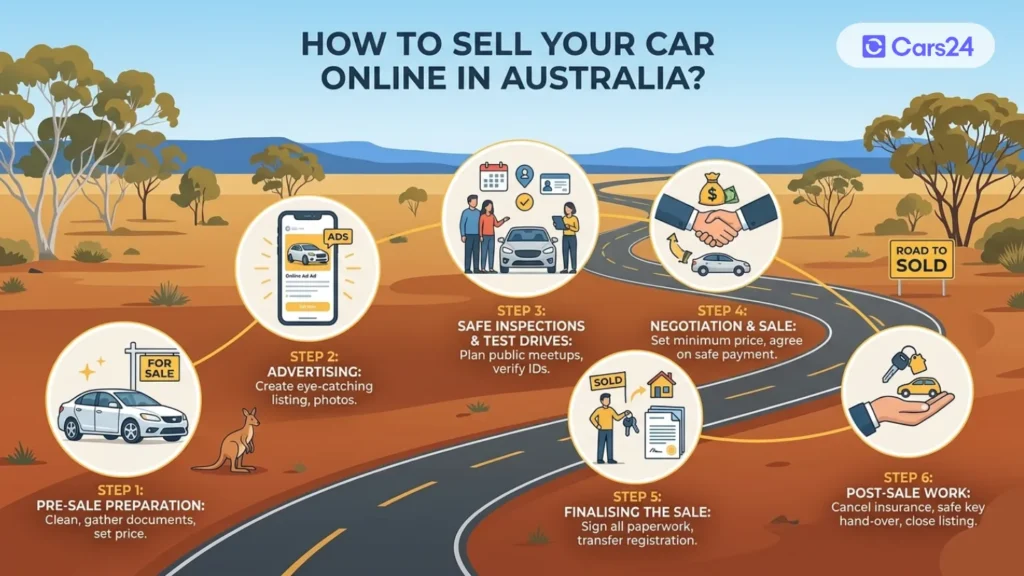
Step 1: Pre-sale preparation
Start by confirming you can legally resell the car and that it’s presented well enough to justify your asking price. If the car is under finance, request a payout letter from your lender. This shows buyers exactly what’s owed and allows the loan to be cleared at the sale.
Roadworthy requirements vary by state, but you should check early:
- VIC: Roadworthy Certificate (RWC)
- QLD: Safety Certificate
- NSW: Pink Slip (for older cars at rego renewal)
Pricing is where most sellers lose money. Use both private sale and trade-in values as a guide, and factor in mileage:
- ~15,000km/year is the average in Australia
- Lower = stronger pricing power
- Higher = expect negotiation
Before listing, handle the basics:
- Clean the car properly (inside and out)
- Fix small faults (lights, fluids, chips)
- Check tyre tread (legal minimum ~1.5mm)
Also, get your paperwork in order, service history (it’s very helpful), rego papers, spare keys, and receipts. These build buyer confidence quickly.
Readers also asked: Mistakes to avoid before selling your car
Step 2: Advertising
This stage is about attracting genuine buyers while filtering out the rest.
Choosing your selling method
It comes down to time vs return:
- High-value/low-km cars: Best suited to dealer-bidding platforms
- Older cars (10+ years / 150,000km+): Often sell better privately
- Need it gone fast: Instant offers (e.g. selling on Cars24) can close within 24-48 hours
Roadworthy and legal requirements may vary depending on the selling method and state.
| Selling model | Best for | Expected price | Speed and effort |
|---|---|---|---|
| Private online marketplace | Maximising every dollar | Highest | Slow/high effort; You handle ads, enquiries, and test drives |
| Dealer-bidding/hybrid | A balance of price and ease | Mid-range | Moderate; dealers bid on your car; the platform manages much of the process |
| Instant online offer | Fast, guaranteed sale | Competitive (often beats trade-in) | Very fast; sell in as little as 24 hours with minimal paperwork |
| Dealer trade-in | Convenience when buying new | Lowest | Instant; quickest turnover but nets the lowest return due to dealer margins |
High-impact visuals
Your photos do most of the selling.
- Use a front three-quarter shot as the lead image, in natural light
- Include 8–15 photos: all angles, interior, dashboard (engine on), tyres, and engine bay
- Show imperfections upfront to reduce negotiation later
Strategic ad copy
Keep it clear and searchable.
- Use terms like “one owner,” “full service history,” “low km”
- Mark the price “Firm” if non-negotiable; otherwise, expect some wiggle room
- Add a short, logical reason for selling
Avoid aggressive phrases like “no time wasters”; they tend to put off genuine buyers.
Quick checks before listing
- Confirm your insurance excess for test drives (especially for unlisted drivers)
- Blur number plates in photos
- Consider a secondary phone/email to limit spam
Also read: Tips and tricks to sell your car
Step 3: Safe inspections and test drives
This is the highest-risk stage when selling privately, so stay in control of the setup.
Choose the right location
Meet in a public, busy place (e.g. petrol station) and stick to daylight hours. Avoid home meetups where possible.
- Bring someone with you, or share your live location
- Good lighting helps buyers assess the car properly and reduces disputes
Verify the buyer
Before handing over the keys:
- Check and photograph their driver’s licence
- Clarify any insurance excess for test drives
Control the test drive
Keep it short and structured:
- Plan a 5–10 minute route, including a higher-speed stretch
- Stay in the passenger seat at all times
- Never let the car out of your sight or control
Keep it low-risk
- Clear out personal documents from the car
- If possible, offer a cold start; it builds buyer confidence
Professional car inspections (via dealers or platforms) are typically lower risk, as they follow a controlled process.
Watch for red flags
- Distraction tactics during inspection
- Sudden claims of major faults to force a discount
If something feels off, pause or walk away.
Step 4: Negotiation and sale
Go in with a clear minimum price based on your research. If the buyer meets it, move to close. Use simple triggers: “If you can do $X, we can finalise today.” If lowballed, point back to value pillars like low km, service history, condition, etc.

Use secure payment methods
Meet the buyer at your bank for high-value sales (e.g., over $10,000). Have them perform the transfer in front of a teller who can verify that the funds are cleared and irreversible. Never hand over the car until the cheque has physically cleared in your account.
Get essential documentation
You must provide a signed “Bill of Sale” receipt. Two copies are needed (one for you, one for the buyer) and should include the buyer’s and vehicle’s details, time and date of sale and “Sold as is, where is.”
No negotiation hassle for professional buyers
You receive a data-driven and firm quote based on wholesale market data from a dealer or instant cash offer platforms. Expect little to no negotiation with them.
Optional but useful
- Ask the buyer to increase transfer limits in advance
- Take a small holding deposit ($200–$500) if needed, with a clear deadline
Watch for red flags
- Fake payment receipts
- Overpayment requests
- Buyers offering full price without inspection
If you’re selling to a dealer or instant-offer platform, expect a fixed price with little to no negotiation.
Step 5: Finalising the sale
The sale isn’t complete until the car is no longer legally tied to you.
Lodge Notice of Disposal (critical)
Do this immediately after the buyer takes the car.
- NSW/ACT: Notice of Disposal
- VIC/QLD/WA/SA: Transfer of Registration
Until it’s processed, you remain liable for fines, tolls and offences. Most states (e.g. Service NSW, VicRoads) allow this to be done online instantly.
Wrap up insurance and tolls
- Cancel or transfer your insurance (pro-rata refunds may apply)
- Remove toll tags (E-Toll/Linkt) and unlink the vehicle from your account
Hand over everything
Once payment is cleared and paperwork signed, provide:
- All keys (spare, valet, accessory keys)
- Service history and manuals
- Accessories (e.g. roof racks, canopy)
- Spare tyre and tools
If selling to a dealer or platform, they usually handle contracts and registration transfer, with payment often completed within 24 hours of pickup.
Final checks
- Keep your Bill of Sale and disposal confirmation as proof
- Remove personal data from the infotainment system
- Leave a small amount of fuel as a basic courtesy
Avoid legal pitfalls
- Don’t leave transfer forms incomplete (“unsigned transfer” risk)
- Notify authorities if plates are being changed
These steps ensure you’re fully cleared, financially and legally, once the car is gone.
Step 6: Post-sale work
This step is essential for closing your financial and legal loop.
Reconcile your insurance
Most Australian insurers will refund the unused portion of your premium, minus a small admin fee, after selling your car. Also, ensure your insurer protects your no-claim bonus (NCB).
Do digital de-linking
If your car has an app (like FordPass, Tesla, or Mercedes me), you must “unpair” the VIN from your account. Factory reset the car’s software during the handover.
Government & toll reconciliation
Check the PPSR status 24–48 hours after the sale. Check your Linkt or E-Toll statement a few days later. If you see any discrepancy, use your Bill of Sale to lodge a dispute immediately.
Tip 1: Update your parking permits
If you have a Council Residential Parking Permit, notify your local council. If the new owner parks in your street using your old permit, you could be hit with a “misuse of permit” fine.
Tip 2: Keep documents for tax records
If the car was used for business purposes (even partially), keep your Bill of Sale and disposal records for 5–7 years. The ATO may require proof of the sale price.
Cautions & red flags
A buyer may call later, claiming a mechanical issue and demanding money back. Unless you intentionally misrepresented the car (which is fraud), you are not legally required to refund them. Politely refer them to the signed Bill of Sale.
You can learn about the proper and detailed differences between a private and dealer-based car sale in Australia here.
How to sell a financed car online in Australia?
The process of selling a financed car in Australia hinges on clearing the encumbrance (the lender’s legal interest) before the registration can transfer to a new owner.
Process for private car sales
Be transparent. Buyers will check the Personal Property Securities Register (PPSR) for any outstanding finance. Obtain a payout letter from your lender, then complete the sale by splitting the payment: the loan amount goes directly to the lender, and the balance to you. Once cleared, provide the buyer with confirmation that the loan has been discharged.
Process for Dealers & Instant Offers
Selling to a business is simpler. You provide a payout letter, and the dealer pays your lender directly from the purchase price, so you don’t need to clear the loan beforehand. If the loan exceeds the offer (negative equity), you’ll need to pay the shortfall to complete the sale.
The final words
Selling your car online is really about choosing the right path for your car and your patience. If you want the highest price, go private, but only if your car has a strong history, good presentation, and you are willing to handle calls, inspections, and some negotiation. If you want the fastest and safest sale, an instant offer or dealer-bidding platform can save you time and stress.
But no matter which path you choose, the rule is the same: prepare properly, price honestly, protect yourself, and finish the paperwork cleanly. This is a good way to sell it smartly, safely, and without leaving money or liability behind.
FAQs
1. How to sell your car online fast?
You can choose the instant offer (direct sale) and dealer-bidding platforms, which can typically complete a sale in 24–48 hours.
2. How to sell your car online for cash?
The instant offer and dealer-bidding platforms offer the most reliable way to sell your car online for cash in Australia.
3. What is the paperwork for selling a car in Victoria?
Essential Victoria paperwork checklist to sell your car: RWC, Transfer of Registration Form, Notice of Disposal (NOD), Proof of Sale/Receipt, and Proof of Ownership.
4. How to sell my car in Melbourne for cash?
Selling for cash typically involves a bank transfer (like Osko) or a physical payment upon car collection in Melbourne, Victoria. You can go for a private car sale, instant offer and dealer-bidding platforms for a cash car deal.
5. How to sell my car for cash in Brisbane?
You can choose any of the private car sales, instant offers, and dealer-bidding platforms for a cash car deal in Brisbane, Queensland.

Comments
New Comment