





Have you ever stood at a service station looking at your tyre placard saying “240 kPa,” only to find the air pump displaying PSI instead? Your car speaks one language, your gauge speaks another, and suddenly a simple tyre top-up feels more complicated than it should.
But tyre pressure conversion doesn’t need to involve long conversions or guesswork. Whether your vehicle lists pressures in kPa, PSI, or Bar, there are simple formulae and tables to translate those numbers instantly and set your air pump correctly.
Let’s see how the different pressure units relate to each other, a quick conversion table, and where to find the recommended tyre pressure for your car.
What is tyre pressure?
Tyre pressure is the force exerted by the compressed air against the inner walls of the tyre. Maintaining the right tyre pressure is crucial for safety, cost-saving, and fuel efficiency. Car manufacturers always specify “cold” tyre pressure. Check the sticker inside your driver’s door jamb for your car’s recommended tyre pressure and dimensions.
What PSI should car tyres be?
Most passenger vehicles operate between 30 and 42 PSI, but you should always follow the pressure shown on your vehicle’s tyre placard rather than using a generic figure.
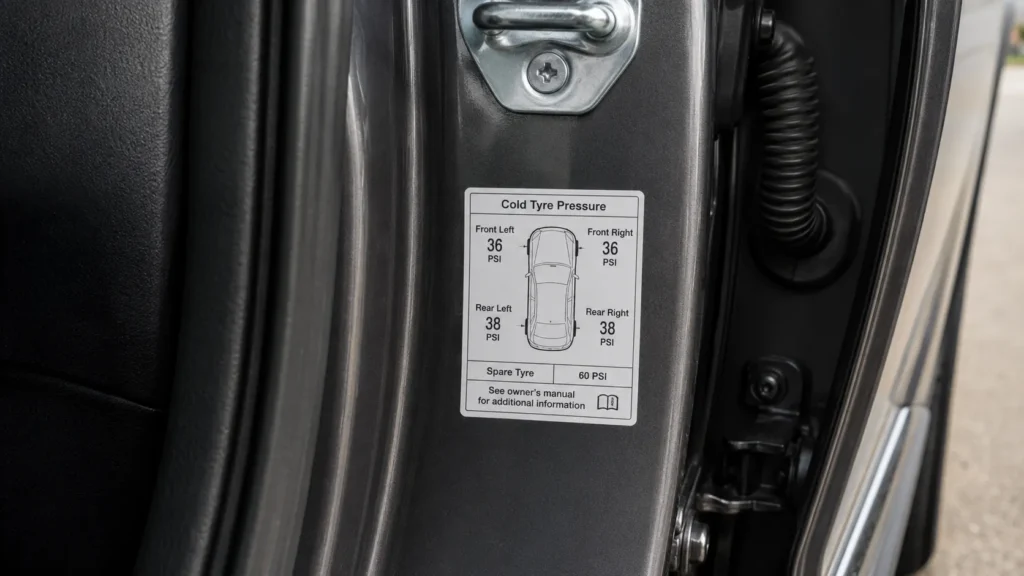
The recommended pressure varies depending on the vehicle, tyre size, load, and driving conditions. You should also adjust tyre pressure based on driving conditions: increase for heavy loads and decrease for beach driving. The 30-42 PSI range converts to 2.07-2.9 bar or 207-290 kPa.
Readers also asked: How to fix a flat tyre?
Why tyre pressure units can be confusing in Australia?
Australia officially uses the metric system for car tyre pressure, so vehicle door placards typically show pressures in kPa (kilopascals). However, due to cultural ties to imperial measurements and the use of US/UK automotive equipment, many air gauges, 4×4 deflators, and older service station pumps display PSI. In contrast, European imports like Volkswagen and BMW often list pressures in bar.
Understanding tyre pressure units
Tyre pressure units can be seen as different languages measuring the same thing: the air pressure inside your car’s tyre. In Australia, the main tyre pressure units are PSI (usually 30-40), kPa (usually 200-280), and bar (usually 2-2.8).
What is a kilopascal (kPa) in tyre pressure?
Tyre pressure is officially measured in kilopascals (kPa) in Australia, though many older drivers still use PSI. Australian vehicle placards typically use kPa, while many modern service-station inflators allow users to switch between kPa, PSI and bar.
Find your vehicle’s kPa on the tyre placard, a small silver, white, or blue sticker, typically located inside the driver’s door jamb, inside the fuel filler cap, or on the glovebox lid.
What is pound per square inch (PSI) in tyre pressure?
PSI (Pounds per Square Inch) is an imperial pressure unit commonly used on tyre gauges, inflators, and aftermarket pressure monitoring equipment. While Australian vehicle placards usually display kPa, many motorists still use PSI when checking tyre pressures.
What is the bar in tyre pressure?
The bar is a metric unit for atmospheric and tyre pressure, mainly seen in European import cars like Volkswagen, BMW, Audi, Mercedes-Benz, and Volvo.
What is the pressure unit in the SI system?
The pascal (Pa) is the SI unit of pressure, with the kilopascal (kPa) commonly used for everyday applications like tyre pressure, as a pascal is a small unit. 1 kPa = 1000 pascals.
Readers also asked: What are different car tyre types?
Tyre pressure conversion: PSI to kPa to Bar
Most service station air pumps allow you to switch between these three units using a “Unit” or “Mode” button. Always verify the pressure unit before inflating your car’s tyres. Now here is a quick tyre pressure conversion table for typical car tyre pressures and how to convert these tyre pressure units using conversion formulae:
Quick tyre pressure conversion table for cars in Australia

Most passenger cars in Australia run on pressures between 210 kPa and 260 kPa. Heavy SUVs, 4WDs, and Utes often require higher pressures up to 280 kPa or more.
| PSI | kPa | bar | Typical used for |
|---|---|---|---|
| 29 PSI | 200 kPa | 2.0 bar | Small hatchbacks (light loads) |
| 32 PSI | 220 kPa | 2.2 bar | Standard sedan / Universal old-school setting |
| 35 PSI | 240 kPa | 2.4 bar | Modern mid-size SUVs and sedans |
| 38 PSI | 260 kPa | 2.6 bar | Heavily loaded vehicles / Highway driving |
| 42 PSI | 290 kPa | 2.9 bar | Large 4WDs, Utes, and towing vehicles |
kPA to PSI tyre pressure conversion formula
- Formula: PSI = kPa ÷ 6.89476
- Petrol station mental shortcut: Divide kPa reading by 7
- Example: 240 kPa ÷ 7 = 34.3 PSI
kPA to bar tyre pressure conversion formula
- Formula: bar = kPa ÷ 100
- Petrol station mental shortcut: Move the decimal point two places to the left
- Example: 260 kPa = 2.6 bar
PSI to kPA tyre pressure conversion formula
- Formula: kPa = PSI x 6.89476
- Petrol station mental shortcut: Multiply by 7
- Example: 32 PSI x 7 = 224 kPa
Bar to kPA tyre pressure conversion formula
- Formula: kPa = bar x 100
- Petrol station mental shortcut: Move the decimal point two places to the right
- Example: 2.4 bar x 100 = 240 kPa
Bar to PSI tyre pressure conversion formula
- Formula: PSI = bar × 14.5038
- Petrol station mental shortcut: Multiply by 14.5
- Example: 2.2 bar x 14.5 = 31.9 PSI
PSI to Bar tyre pressure conversion formula
- Formula: bar = PSI ÷ 14.5038
- Petrol station mental shortcut: Divide by 14.5
- Example: 35 PSI ÷ 14.5 = 2.41 bar
FAQs about car tyre pressure conversion
1. What is the most common tyre pressure unit used in Australia?
kPa is Australia’s official tyre pressure standard, although many tyre gauges and motorists continue to use PSI. Australian service stations commonly provide both units.
2. What is the tyre pressure conversion chart for typical cars on Australian roads?
| PSI | kPa (multiply PSI by 6.8948) | bar (divide kPa by 100) |
|---|---|---|
| 30 | 207 | 2.07 |
| 31 | 214 | 2.14 |
| 32 | 221 | 2.21 |
| 33 | 228 | 2.28 |
| 34 | 234 | 2.34 |
| 35 | 241 | 2.41 |
| 36 | 248 | 2.48 |
| 37 | 255 | 2.55 |
| 38 | 262 | 2.62 |
| 39 | 269 | 2.69 |
| 40 | 276 | 2.76 |
| 41 | 283 | 2.83 |
| 42 | 290 | 2.90 |
3. Can I use a PSI-only gauge on a car that uses kPa?
Yes, absolutely. You just need to convert your car’s required kPa number into PSI using the quick formula (kPa ÷ 7 = PSI) before checking or inflating the tyre.
4. Where can I find the recommended tyre pressure for my car?
You can find your car’s exact specifications in three main places: the tyre placard, the owner’s manual and the OEM websites.

Comments
New Comment