




When you’re looking to buy a car, you’ll probably check the price, kilometres and service history fairly early. Engine details can take a bit more work to figure out.
Is a 1.5-litre engine enough for what you need? Does “turbo” mean it’ll use more petrol? And if you buy a hybrid, will you need somewhere to plug it in? You shouldn’t have to know all this already. But it helps to understand what you’re choosing before you take on the fuel bills and maintenance.
We’ll explain the main car engine types, what those numbers in a listing mean, and how to choose the right fuel at an Australian servo. We’ll also cover fuel and charging costs, plus the checks that matter when the car has already had a previous owner.
What do engine size, turbo, power and torque mean?
A petrol or diesel engine burns fuel to help turn the car’s wheels. Burning fuel pushes parts called pistons up and down inside tubes called cylinders, and the engine uses this movement to help turn the wheels. The table below explains the engine terms you’ll see when comparing cars.
| What the listing says | What it means in simple English | What should you check? |
| Engine size: 1.5L, 2.0L and so on | The total space the pistons move through inside the cylinders. A 2.0-litre engine has more of this space than a 1.5-litre engine. | This is not the fuel-tank size or the amount of petrol it uses. Look at L/100km to compare fuel use. |
| Three, four or six cylinders | How many cylinders the engine has. A four-cylinder engine has four pistons working inside four cylinders. | More cylinders do not automatically make a car a better buy. Check how smoothly it drives, its fuel use and servicing costs. |
| Turbo | A turbo pushes extra air into the engine. With more air and fuel, the engine can make more power. | A small turbo engine can be powerful enough for a larger car. Don’t judge its ability by engine size alone. |
| Power: measured in kilowatts, or kW | How quickly the engine can do work. More power can help a car build speed, but a heavier car takes more effort to move. | On a test drive, check whether it builds speed comfortably when joining a main road. Compare cars of similar size and weight. |
| Torque: measured in newton metres, or Nm | The engine’s turning force. Think of turning a tight lid: the twisting effort you apply is torque. | Torque helps the car pull away and move a load. For towing, check the car’s towing and weight limits, not just its torque figure. |
Should you choose a 1.5-litre or a 2.0-litre engine? Don’t pay more for the bigger engine just because it sounds better. A smaller engine with a turbo can be more powerful than a larger one without it because engine size alone won’t tell you which car uses less fuel, either.
When you compare used cars, look at the engine details alongside fuel consumption, service history and how the car feels to drive. You want enough performance for your normal journeys, with running costs you’re comfortable paying.
Car engine types: petrol, diesel, hybrid or electric?
When a listing mentions the powertrain, it means what powers the car and how that power reaches the wheels. A petrol car uses an engine, an electric car uses a motor, and a hybrid uses both.
Petrol
With a petrol car, you fill the tank at a servo and drive until you need more fuel. There’s no charging to organise. Before buying, find out which petrol the engine needs.
Some cars require premium petrol, which costs more per litre than regular unleaded. We explain those fuel grades below. Check the version you’re buying, too. A model such as the Toyota Corolla comes in petrol and hybrid versions, so the name on the boot doesn’t tell you the whole story.
Diesel: think about your journeys
Diesel can suit long-distance driving and some towing needs. But low fuel consumption is only part of the bill: purchase price, servicing and repairs matter too.
Many modern diesels have a diesel particulate filter, or DPF, which traps soot from the exhaust. It needs suitable operating conditions to burn that soot away, a process called regeneration.
Repeated short trips can interrupt this cleaning process. Ford’s DPF guidance explains why short-distance use can lead to blockages. Follow the handbook for the specific vehicle; there is no single driving routine that suits every diesel.
Conventional hybrid
You don’t plug in a conventional hybrid; it usually combines a petrol engine with an electric motor. The car controls when each one works.
As you slow down, it captures some energy that would otherwise be wasted and stores it in a battery. That energy helps power the motor later. The engine can also charge the battery.
This is particularly useful in stop-start traffic. You still buy petrol and service the engine, but electric assistance can reduce fuel use. Our hybrid car guide also explains mild hybrids, which provide more limited help from electricity.
Plug-in hybrid
The important word here is plug-in. This hybrid has a battery you can charge from an external power supply, as well as an engine. Charge it regularly, and you could do short daily trips on electricity. On longer journeys, the engine can keep you going after that electric range runs out.
You can generally drive a plug-in hybrid without charging it, but you’ll use more petrol. Before paying extra for one, ask yourself where you would plug it in. Its very low advertised fuel-use figure assumes you use electricity for some of your driving.
Battery electric: start with where you’ll charge
A battery electric vehicle, or BEV, uses electric motors and has no combustion engine and you charge its battery from an external electricity source.
Before buying, check charging options near home, work and along regular longer routes. Look at connector compatibility, charging speed and prices. Public charging can work, but it needs to fit your routine.
For a used EV, ask for a battery state-of-health report. This describes the battery’s condition compared with when it was new. The Australian Government recommends this check in its used-EV buying guidance.
Which petrol should you use: 91, 95, 98 or E10?
Before buying a petrol car, check the fuel label inside its fuel flap or read the handbook. The right petrol is the one the manufacturer says the car can use. If it needs premium, allow for that extra cost in your fuel budget.
The numbers 91, 95 and 98 are octane ratings, also called RON. They tell you how well petrol resists burning in an uncontrolled way inside the engine, known as “knocking”. A higher number doesn’t automatically make your car run better.
- 91: Regular unleaded. Use it if the manufacturer allows it.
- 95: Premium unleaded. Some engines need at least this rating.
- 98: Higher-octane premium. Paying extra won’t guarantee fuel savings.
- E10: Petrol containing up to 10% ethanol, a type of alcohol. Your car must accept both this blend and its octane rating.
What if the label says “minimum 95”? Don’t use 91. If it says “95 recommended”, check the handbook before choosing a lower grade.
Our guide to petrol types in Australia explains these choices further. With an older car, confirm E10 compatibility before filling up.
How do you compare fuel use and running costs?
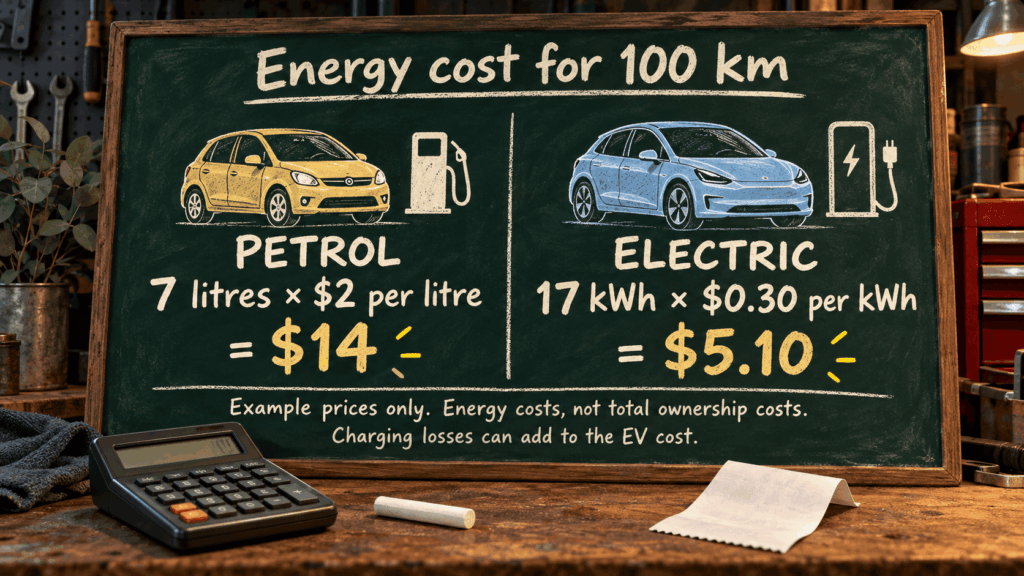
See 7L/100km in a listing? That means the car uses seven litres of fuel to travel 100 kilometres. A lower number means less fuel used under the same conditions. Electric cars measure electricity use instead. 17kWh/100km means 17 units of electricity for that distance. So, what does that mean for your wallet? Multiply the amount used by the price you pay:
| Over 100km | Example price | Energy cost |
| Petrol car using 7 litres | $2 per litre | $14 |
| Electric car using 17kWh | 30 cents per kWh | $5.10 |
These are illustrative prices and consumption figures, not current quotes or a full ownership-cost comparison. EV charging losses can increase the electricity you pay for, and public charging prices also differ from home tariffs.
Then think about how far you drive each week. For a plug-in hybrid, count both petrol and electricity. Add servicing, insurance and the purchase price before deciding which car is cheaper to own.
Your results will also change with traffic, hills, speed and air-conditioning. Compare official figures from the same test system where possible.
Want help judging whether a car’s fuel use is good? Our fuel economy guide explains what to look for and why everyday driving can give different results.
Frequently asked questions
Is a hybrid worth buying if I only drive a few thousand kilometres a year?
A lower petrol bill is appealing, but how much extra are you paying for the car? If the hybrid costs $3,000 more and saves you $500 a year in fuel, you’ll need six years to recover that difference. That’s just an example, excluding insurance, servicing and resale. Use the prices of the actual cars you’re considering.
Can I own an electric car if I can’t charge at home?
You can, provided charging elsewhere fits into your week. A charger at work could make things easy. One that needs a separate trip and a long wait might become frustrating.
Before buying, check nearby chargers, their prices and whether they suit the car. Our guide to EV ownership without home charging covers what to plan for.
Does putting 98 petrol in my car make it cheaper to run?
Not automatically. If your car accepts 91, paying for 98 doesn’t guarantee enough fuel savings to cover the higher price. Some engines benefit more than others.
The handbook has the final say. “Minimum 95” means you shouldn’t use 91, regardless of the price difference. Here’s our explanation of Australian petrol grades.
What should I ask the seller about a used hybrid’s battery?
“Has the battery been tested, and can I see the results?” is a useful place to start. Then ask what battery warranty remains and whether it transfers to you.
Service records matter too, because the car still has an engine. If the battery’s condition is unclear, arrange a check by someone familiar with that hybrid system before committing.
My driving is mostly school runs and shopping. Should I buy diesel?
For that routine, compare petrol and conventional hybrids first. Many modern diesels have a filter that catches exhaust soot. Repeated short trips can prevent it from getting the conditions it needs to clean itself.
A regular longer journey could change the picture, but check the particular car’s handbook. Our diesel buying guide explains the trade-offs.
What happens if I don’t plug in a plug-in hybrid?
It will generally keep driving using fuel and its hybrid system, assuming there’s fuel in the tank and everything is working normally. You don’t have to stop simply because the electric-only range has run out.
You will, however, miss much of the fuel-saving benefit of charging. If plugging in isn’t practical, consider a conventional hybrid, which doesn’t need a charger.
Why might my fuel bill be higher than the listing suggests?
The listing’s fuel figure comes from a controlled test. Your trips involve different traffic, speeds, hills and loads. Short journeys and air-conditioning can affect consumption too.
Use the published figure to compare cars, rather than to promise yourself an exact weekly bill. Our fuel economy guide helps you work out what those numbers mean.
What maintenance costs should I allow for with a used electric car?
There’s no engine oil to change, but you’ll still pay for tyres and other parts that wear out. Brakes, suspension, cabin filters and relevant cooling systems also need attention.
Ask for the manufacturer’s service schedule and check what work is due next. Our used electric car buying guide covers battery checks and warranty questions as well.
Comments
New Comment