




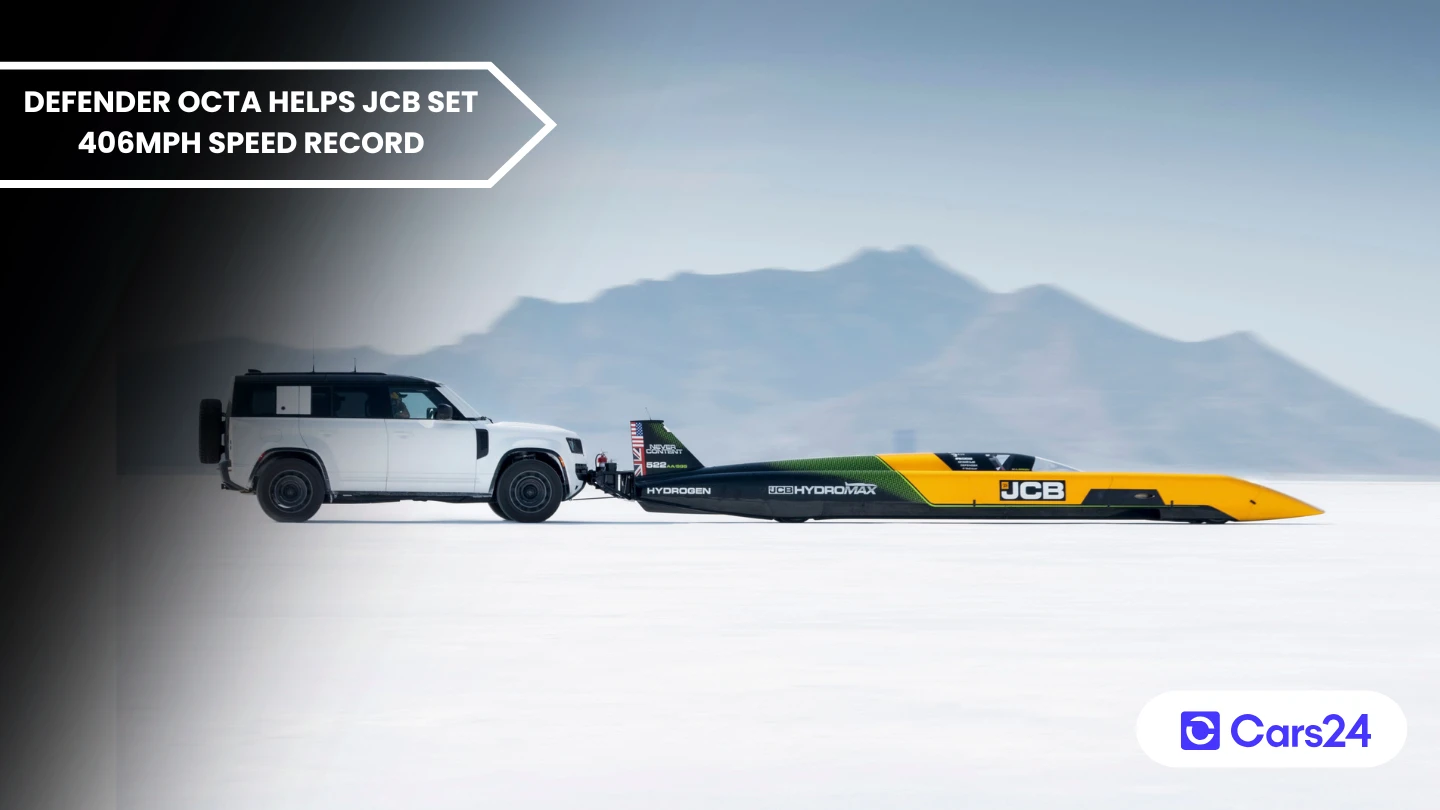
A specially adapted Defender Octa played a key role in helping the JCB Hydromax set a land speed record for a hydrogen combustion vehicle at the Bonneville Salt Flats in Utah, USA. The 467kW Defender Octa pushed the 2,550kg Hydromax from a standstill at the start of each record run.
The rules allowed the JCB to receive a push for a maximum of 300 metres, giving it enough speed to take over under its own power.
The JCB Hydromax eventually reached 406.320mph (or 653.9km/h), setting both a Southern California Timing Association Speed Record and an FIA world hydrogen land speed record. World land speed record holder Andy Green OBE drove the vehicle.
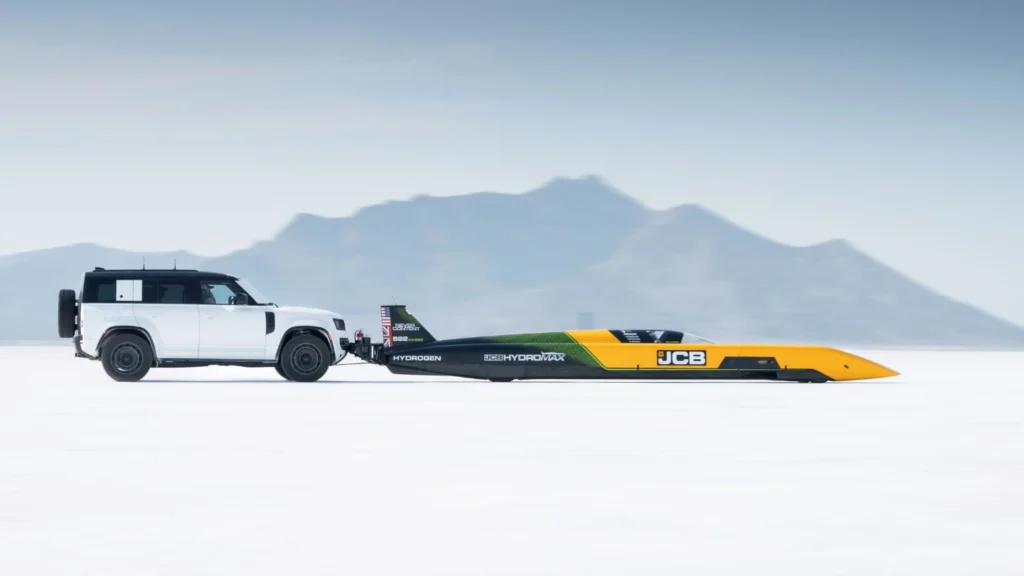
The JCB Hydromax is a 32-foot-long, highly specialised, one-off hydrogen-powered land speed record streamliner. It is powered by two heavily modified 4.8-litre internal combustion engines fed by gaseous hydrogen, combined to produce roughly 1,600 horsepower (or 1,193 kW).
Why JCB chose the Defender Octa
JCB needed a push vehicle that could deliver strong acceleration while staying composed on the loose surface of the Bonneville Salt Flats. The team chose the Defender Octa after extensive testing and analysis and fitted it with a bespoke push plate.
The Defender’s integrated, crash-tested winch mount provided the mounting point for the plate. Engineers disabled the mount’s deformable crumple zone, added extra fixing points and fitted a brace bar to the front recovery point.
They then tested the push plate at speeds well above those required by JCB to make sure it could handle the job.
The Octa had to hit 60mph within 300 metres
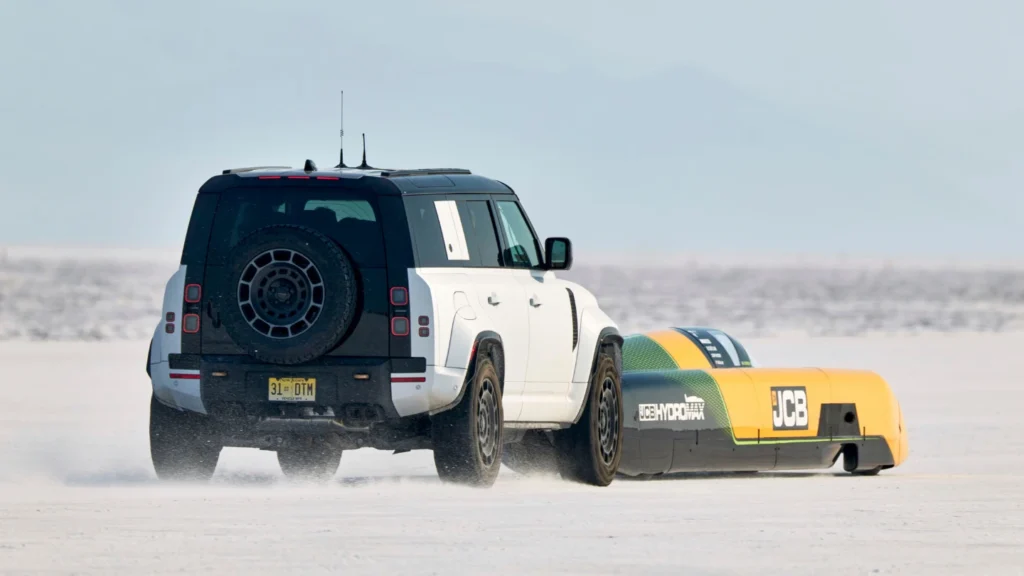
The Defender Octa had to push the Hydromax from 0 to 60mph (97km/h) within 300 metres during every record attempt. The team faced an effective altitude density equivalent of up to 2,244 metres above sea level, along with the loose surface of the salt flats.
The Octa’s twin-turbo V8 handled the task without difficulty, and its 48V mild-hybrid system also improved throttle response and sprint performance. Once the Hydromax passed 60mph, it could accelerate under its own power.
6D Dynamics kept the push steady
The Defender Octa’s innovative 6D Dynamics suspension proved just as important as its engine. Every Octa gets hydraulically linked, continuously variable semi-active dampers which control body roll and pitch during hard acceleration, helping the vehicle maintain a level attitude.
That mattered because the push plate had to stay at the correct angle while the Defender accelerated with the much heavier Hydromax attached to its front.
Also read: 2027 Land Rover Defender gains Vertex variant and six-seat option
Bonneville created another challenge
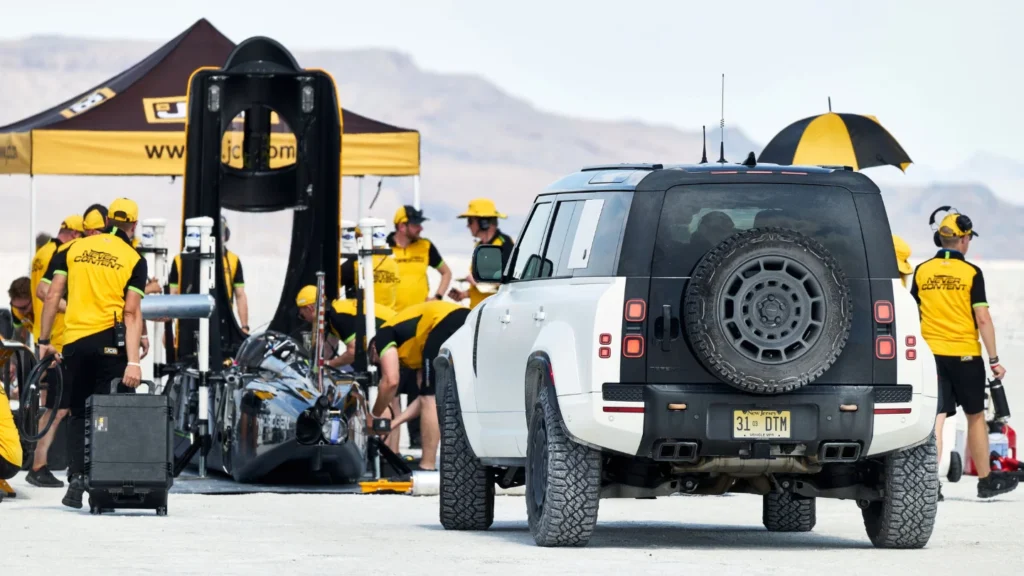
The team also had to deal with changing conditions at the salt flats.
JCB Hydromax Chief Engineer Lee Harper said the surface was extremely loose and the effective altitude increased as temperatures rose during the day. Those conditions can challenge naturally aspirated engines.
JCB therefore considered the Defender Octa’s all-wheel-drive system and twin-turbo V8 a strong combination for the job.
Harper also described the project as an opportunity to combine the skills of two British engineering companies.
The Octa did more than push the Hydromax. Its high-performance all-terrain capability allowed it to quickly reach the JCB after each attempt so the team could prepare for the return run, and some of those positions sat miles away from the original push location.
What powers the Defender Octa?
The Defender Octa replaced the older 5.0-litre supercharged engine with a BMW-sourced 4.4-litre twin-turbo mild-hybrid V8. It produces an output of 467kW / 800Nm and can accelerate 0-100km/h in 4.0 seconds.
JLR positions the Octa as its flagship high-performance “super SUV”, combining serious off-road capability with performance aimed at the level of premium performance vehicles. The model targets rivals such as the Mercedes-AMG G 63.
Defender also remains one of the best-selling large SUVs over $80,000 in Australia in 2026, topping its segment recently in July 2026.

Comments
New Comment