




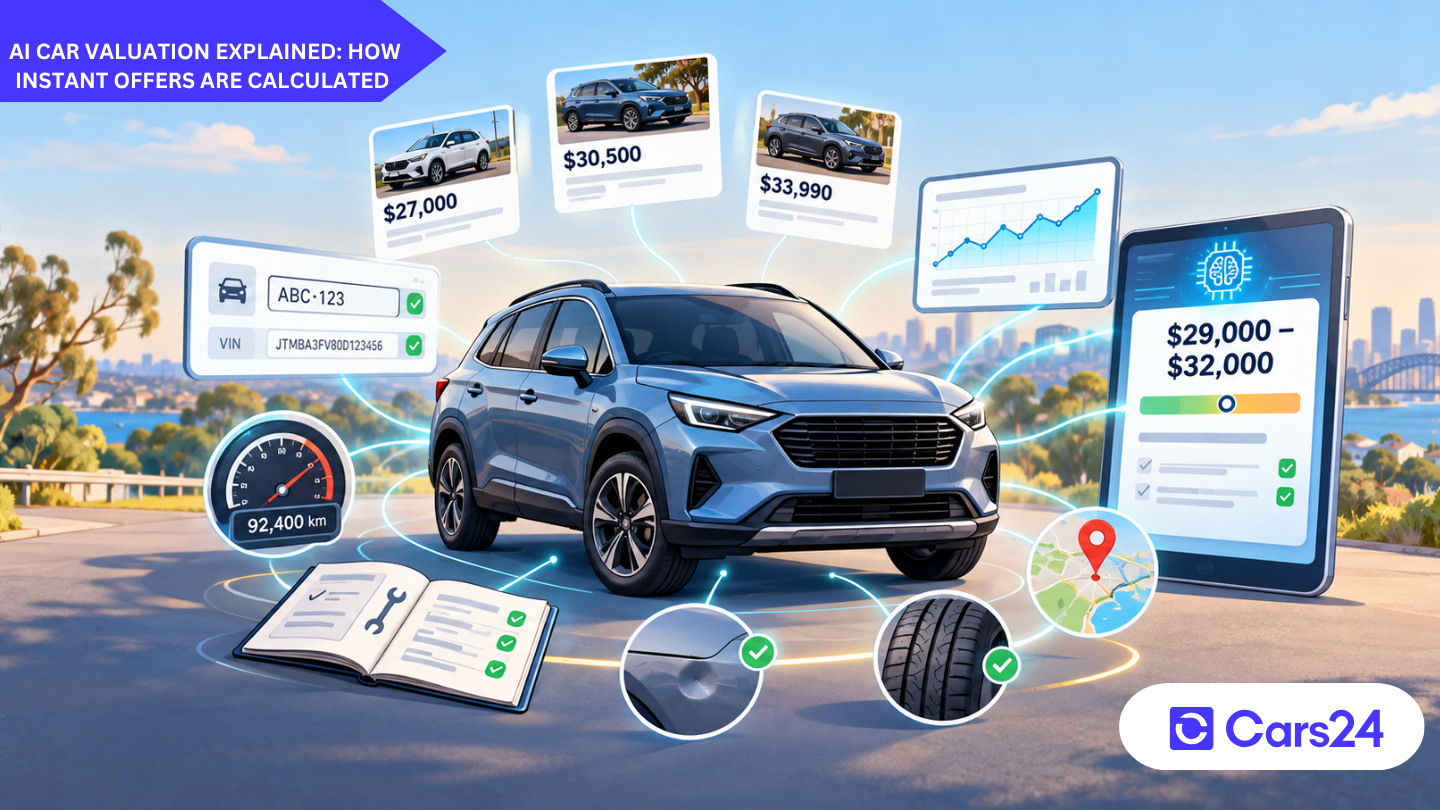
The annoying part about selling a car usually starts before you have even spoken to a buyer. You just want a rough idea of what the car is worth, so you have a look online and find a few similar ones. Easy enough, except one is listed for $27,000, another is sitting at $30,500, and someone else is asking nearly $34,000 for what looks like almost the same car.
So, you choose to try an online valuation instead. You follow the routine by putting in your rego, adding the kilometres and filling in a few details about the car. A moment later, you’ve got a number in front of you. That is the bit most people pause at. How can a tool put a value on your car that quickly?
The answer is that these valuations are not based on one similar car or a single price sitting in a database. They work by comparing the details of your vehicle with a much larger pool of market information.
That wider comparison is exactly what sits behind Cars24 Australia’s ValueCheck. Rather than judging your car against one or two similar listings, our proprietary valuation model processes data from 70,000 car listings every month, including listing and delisting prices. It then considers details specific to your car, such as its age, kilometres, location, type, popularity and condition, to help work out where it sits in the current market.
So the number is not coming from one similar car or a fixed price guide. The model is looking at your vehicle alongside a much wider slice of the used-car market and estimating where it sits based on the information available at that point.
That is really what an AI car valuation is doing: taking the details of your car, matching them against current market patterns and turning all of that into a usable estimate.
What is AI actually doing when it values a car?
If you were trying to work out what your car is worth on your own, you would probably start by looking for similar cars online. But that only gets you so far, because two cars that look almost the same on a listing can still be very different once you get into the details.
Take a 2021 Toyota RAV4 as an example. One might have 45,000 kilometres on the clock, a complete service history and clean bodywork. Another could have done more than 120,000 kilometres, be a lower-spec variant and have a few dents or worn tyres. They are both 2021 RAV4s, but simply calling them the same car would miss most of what matters when working out a price.
Our valuation model helps sort through those differences. Instead of treating every similar-looking car as equally relevant, ValueCheck uses the information available about your vehicle and the market around it to work out which comparisons make sense. The aim is to get closer to the value of your car, rather than hand you a broad number for every RAV4 built in the same year.
That holds value because used-car pricing rarely comes down to one thing. Kilometres are a good example. A higher odometer reading will generally affect a car’s resale value, but there is no simple rule that takes the same amount off every car for every extra 10,000 kilometres. The age of the vehicle, its condition, the exact model and what buyers are looking for at the time all matter as well.
The same is true of service history. A complete record is useful because it tells us more about how the car has been maintained, but there is no automatic dollar amount attached to a stamped logbook. If you are preparing to sell, our guide to checking your service history before selling explains what records are worth pulling together before the car is inspected.
This is where an AI car valuation saves a seller a fair bit of work. You could spend an evening opening listing after listing, trying to decide which cars are genuinely comparable and why their prices are so different. ValueCheck is built to do that sorting at scale, using the details of your car to make sense of the wider market and turn it into an estimate you can actually use.
It is also why we do not present a valuation as a generic price attached to a make and model. The question we are trying to answer is much more specific: based on what we know about this vehicle and what the market looks like now, where does this particular car sit?
That estimate then gives you a starting point. If you want to understand the other ways sellers can sense-check a number, our guide to how much your car is worth in Australia walks through comparable cars, condition, kilometres and the difference between an advertised price and actual value.
Why not just copy the prices you see online?
Those listings are still useful, but the problem appears once you start comparing them properly: the numbers can get messy very quickly. A car that looks close to yours might be advertised at $27,500, another at $30,000 and another at $33,990. Which one are you supposed to believe?
Part of the confusion is that an advertised price is just that: the price someone is asking. It does not necessarily tell you what the car eventually sold for, and it certainly does not mean your car should sit at the same number.
That is why ValueCheck looks beyond a handful of advertised prices. Our valuation model uses wider market information, including listing and delisting prices, to get a better sense of where similar cars are actually sitting. It means you are not relying too heavily on one seller who may have priced high, one unusually cheap listing or a car that only looks comparable until you check the variant, kilometres and condition.
And timing matters here too. It is important to remember that the market does not stand still. Supply changes, demand moves and your car keeps adding kilometres. A useful online car valuation needs to reflect what is happening now, not just what a similar car was advertised for months ago.
A valuation and an instant offer are not quite the same thing
This is where things can get a little confusing, because the numbers can look like they should mean the same thing when they actually answer different questions.
- An online car valuation is trying to estimate where your car sits in the current used-car market.
- An instant car offer or purchase amount goes one step further and asks: what would a buyer actually pay to acquire this specific car?
That is why a private asking price, a market valuation and a purchase offer do not always line up neatly. A seller might advertise a car at one price, the market may suggest another, and a buyer may arrive at a different amount again once the vehicle itself has been checked.
With Cars24, the process starts online. You enter details such as the rego or VIN, state, kilometres and condition and, where available, receive an initial valuation. If that number makes sense to you and you want to keep going, the car then moves to inspection and verification. That is where we can confirm the details of the vehicle itself before working out the post-inspection purchase amount.
So it is worth treating the first number as a useful starting point rather than the final word. You can check your car’s value with Cars24 ValueCheck to see where your car may sit in the market, then decide whether you want to take the next step.
Why can the number change after inspection?
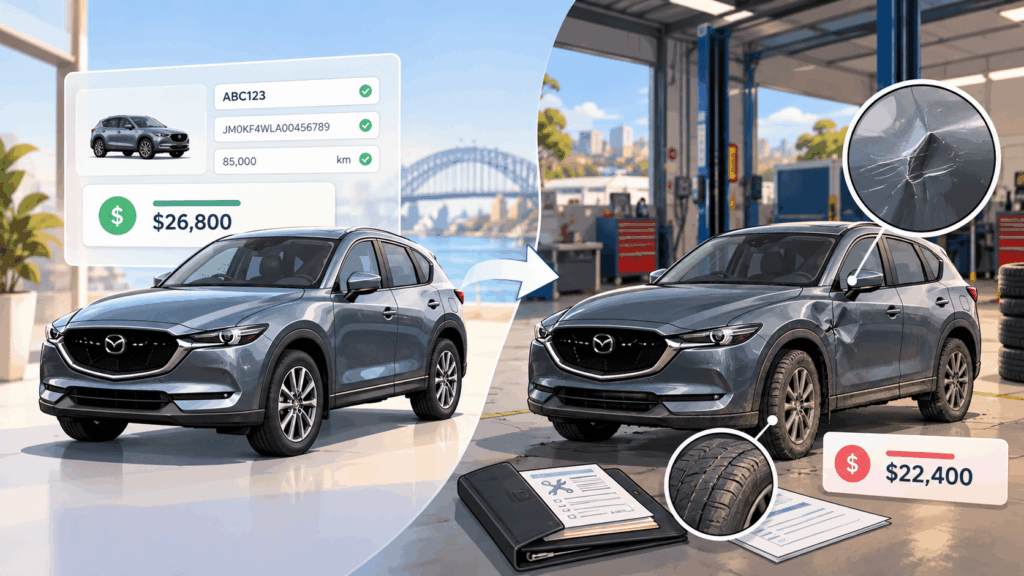
An online valuation can only work with the details available at that stage. You might have entered the correct year, variant and kilometres, but there are still things that need inspection beyond the screen, such as tyre wear, body damage, previous repairs or the general condition of the car.
If the car turns out to be slightly different from the information entered online, the valuation will likely move with it. It could be something as simple as a different variant or higher kilometres, or the inspection may pick up damage or wear that was not obvious earlier. This is also why it is worth being accurate from the start. Enter the real odometer reading, choose the correct vehicle details and mention any damage you already know about. A higher estimate is not much use if it is based on a version of the car that is better than the one being inspected.
If you decide to keep going after the online valuation, our Sell My Car page explains how the rest of the Cars24 selling process works.
Some cars simply need a closer look than others too. A common model with plenty of similar vehicles on the market is usually easier to compare. A rare variant, an older luxury car or a modified vehicle may not have as many close matches available, which can make an online estimate harder to pin down straight away.
That is worth keeping in mind with any car valuation calculator. The first number is there to give you a useful idea of where the car may sit, but sometimes the vehicle itself needs to do a little more of the talking.
There is also a difference between information about your car and information about you. Vehicle details help with the valuation, while personal information is handled separately under our Privacy Policy, where you can read more about what we collect and how it is used.
So, how much should you trust an AI car valuation?
Enough to use it properly, but not so much that you treat the first number as gospel. That’s probably the fairest way to look at an AI car valuation. If you’ve ever tried to work out your car’s value by jumping between listings, you already know how quickly it gets confusing. Same model, similar year, completely different prices… and after a while you’re not really sure which one is closest to your car anyway.
ValueCheck helps cut through some of that. You put in the details of your car and get an idea of where it may sit in the market, without having to do all that comparing yourself.
But there’s still a point where the screen can only take you so far. It doesn’t know what the tyres look like today, whether there’s a dent you forgot to mention or how the car has actually held up over time. That’s why, if you choose to sell with Cars24, we inspect the car as well.
So when you’re asking “what is my car worth?”, the online valuation gives you a useful first answer. Then, if you want to take things further, we look at the actual car and work from there.
It’s really that simple. The AI helps you get a clearer sense of the market, and the inspection helps make sure we’re talking about your car as it actually is.
Frequently asked questions
Why do different car valuation tools give different numbers?
Because they are not all looking at the same data or trying to answer the same question. One tool may be giving you a broad market estimate. Another may be closer to a purchase price. Even the cars being used for comparison can differ.
If you are comparing results, check what each number actually represents before deciding one of them is “wrong”. You can also run your details through Cars24 ValueCheck and use that as another point of reference.
Why is my valuation lower than some cars I can see online?
The short answer: asking price is not the same as sale price.
You may see your model advertised for more, but that car could be a different variant, have fewer kilometres or simply be priced high by the seller. It may also sit unsold for weeks.
Can I value my car if I still have finance owing?
Yes. Finance does not stop you from getting a valuation. It matters later if you decide to sell, because the outstanding amount with your lender still needs to be settled.
If you are in that situation, have a look at our guide to selling a financed car in Australia before you move ahead.
Does accident history affect what my car is worth?
It can if it involves a minor repair but major structural damage is obviously not the same thing, so there is no flat amount taken off every car that has been in an accident.
What matters is what happened, how it was repaired and what condition the car is in now. Our guide to selling a car after an accident covers that in more detail.
Can my car’s value change even if I barely drive it?
Yes, because your car is only one part of the equation. The market around it can move. More of the same model might come up for sale. Demand can drop or pick up. A newer version can arrive.
So if the last valuation you did was months ago, it is worth checking again rather than assuming the number still holds.
What details should I have ready before using a car valuation calculator?
Your rego or VIN, current kilometres and the correct vehicle details are the main ones. Be realistic about car condition too.
There is not much point getting a higher estimate because you selected “excellent” if the car has damage that will be obvious later.
If you decide to sell, you will need a few more things. Our guide to the documents required to sell a car covers those.
Is an online car valuation the final price?
Not necessarily. An online car valuation is based on what is known about the car at that point. If you continue with Cars24, the vehicle still goes through inspection and verification before a post-inspection purchase amount is worked out.
You can see how the rest of that process works on our Sell My Car page.
Does Cars24 use my personal information for the valuation?
We separate what we know about the vehicle from the personal information you provide while using our services. We do not publicly list every individual data field used inside ValueCheck, so it would be misleading to pretend otherwise. If you want to understand how Cars24 collects and handles personal information, our Privacy Policy is the right place to check.
Comments
New Comment