




You’ve probably noticed the conversation getting louder around fuel excise, EV taxes, and the Road User Charge (RUC). You’re probably trying to work out what it’s going to cost you.
Whether you manage a transport business or you’re thinking whether your Tesla will attract a RUC once the temporary relief ends on 1 July 2026, understanding the current picture matters, especially with rates and rules changing in the next 12 months.
That’s where understanding the current RUC picture becomes important. For EV owners, it’s also about the future kilometre-based excise charging. Know who the RUC applies to, how it’s calculated, and how much it is, what the RUC will be after 30th June and where the rules are heading in this blog.
What is a Road User Charge in Australia?
A Road User Charge (RUC) in Australia funds road maintenance and infrastructure. Currently, it is waived for three months (April to June 2026). Otherwise, it only applies to heavy commercial vehicles over 4.5 tonnes via diesel fuel excise at 32.4¢/L, returning fully on 1 July 2026 and increasing to 34.3¢/L from 1 January 2027. Australia is also planning a future EV/PHEV distance-based RUC using odometer or GPS tracking.
How is RUC different from registration and fuel excise?
Registration is a state fee that you pay to operate your vehicle on the road. Road user charge is a federal tax built into petrol and diesel prices that pays for road wear and maintenance.
Who needs to pay a road user charge?
If you drive a heavy truck which has a Gross Vehicle Mass (GVM) or Aggregate Trailer Mass (ATM) of more than 4.5 tonnes (4,500 kg), you pay RUC. If you drive a standard petrol/diesel car, you pay fuel excise instead. There are no road user charges for EV and PHEV drivers yet.
How much are Road User Charges in Australia?
Heavy vehicles have paid road user charges for decades in Australia through the Heavy Vehicle Road User Charge (HVRUC). Light vehicles (petrol/diesel) pay the fuel excise tax.
The federal government is also planning to implement an EV/PHEV road user charge to replace the lost fuel excise revenue. The electric car RUC is on hold for now, as announced in the recent budget.
Road user charge rates for heavy vehicles
If you operate heavy transport in Australia, like commercial freight trucks, semi-trailers, or buses, you pay a fuel-based RUC. A heavy vehicle is any motor vehicle or combination of vehicles that has a Gross Vehicle Mass (GVM) or Aggregate Trailer Mass (ATM) of more than 4.5 tonnes (4,500 kg).
Here is the fuel-based Road User Charge for heavy vehicles:
Scheduled RUC rates for liquid fuel (Diesel/Petrol)
| Time period | RUC (Rate per Litre) | Operational status |
|---|---|---|
| Current (until 30 June 2026) | 0¢/L | Suspended via Federal Budget relief |
| 1 July 2026 – 31 December 2026 | 32.4¢/L | Regular RUC resumes |
| From 1 January 2027 | 34.3¢/L | 6% indexed increase (deferred from July 2026) |
Scheduled RUC rates for heavy vehicles running on gaseous fuel (CNG/LNG)
- Current Rate: 0¢ per kilogram (suspended alongside liquid fuels)
- Resuming 1 July 2026: 43.2¢ per kilogram
Road user charge rates for light vehicles
There is no national road user charge for light vehicles (cars, SUVs, utes), but you pay for road use via the fuel excise tax, which is built into the fuel price at the bowser.
Currently, the fuel excise of 52.6 cents per litre is discounted to 20.6 cents per litre (-32¢ /L) to ease household financial pressure during the Middle East fuel crisis. It will return to the standard rate of 52.6¢/L on 1 July 2026.
Example: How much does 1000km cost for a truck?
Suppose a standard commercial semi-trailer diesel truck for a rough estimation of driving costs over 1,000 kilometres in Australia. This calculation uses the standard tax rate of 32.4¢/L, resuming 1 July 2026.
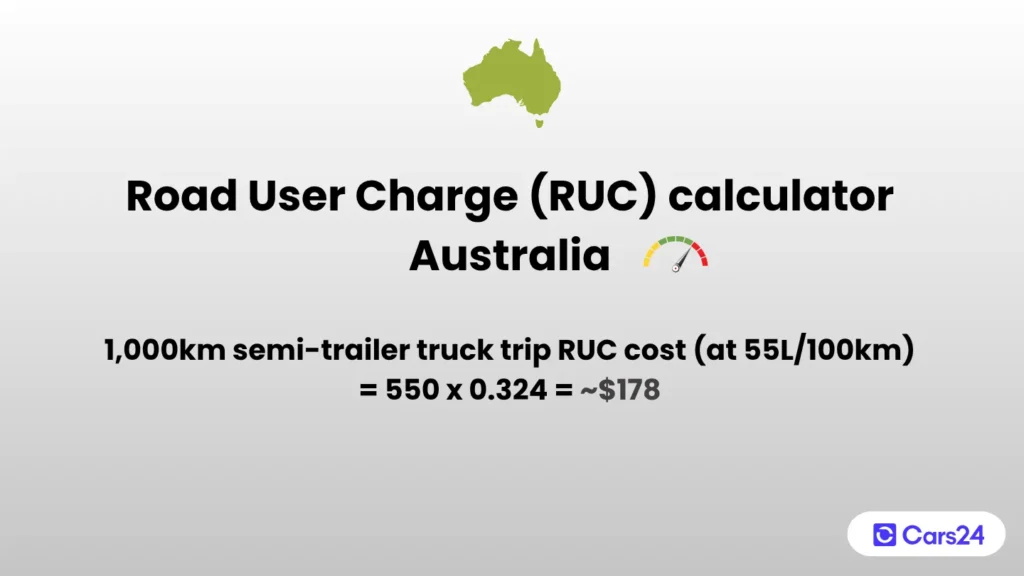
1,000km heavy vehicle trip (semi-trailer truck) cost
- Average efficiency: 55 litres of diesel per 100 km
- Total fuel needed: 550 litres of diesel
- Base resource cost: $935.00 (At $1.70/L wholesale diesel)
- Fuel excise tax: $289.30 (Built into pump price at 52.6¢/L)
- Road User Charge (RUC): -$111.10 (Rebated/paid via ATO net FTC)
- Total cost for 1,000 km: $1,113.20 ($ = AUD)
Temporary Road User Charge relief by the federal government
The three-month waiver of the Heavy Vehicle Road User Charge (April-June 2026) was a direct response to the fuel price crisis caused by the Middle East geopolitical war. It’s scheduled to expire on 30 June 2026. The trucking industry is lobbying heavily for an extension or permanent reduction.
Will there be a federal EV road user charge?
As of May 2026, an EV/PHEV pays zero fuel excise, but a potential distance-based RUC is under consideration by the federal government. The argument for the electric vehicle road user charge in Australia is equity: EV owners use the same roads but don’t contribute to their maintenance through the fuel tax system.
The argument against the EV road user charge is incentives: Governments are trying to encourage EV uptake to meet climate targets. Taxing EVs at the equivalent per-kilometre rate as petrol cars (or even close to it) undermines that incentive.
Readers also asked: Typical costs of owning an EV in Australia
Does the Road User Charge vary by state in Australia?
No, the fuel-based heavy vehicle Road User Charge (RUC) does not vary by state in Australia. It is a uniform, federally-mandated national tax managed under the Commonwealth’s Fuel Tax Act 2006. However, total on-road heavy vehicle costs do vary by state due to different annual registration charges.
How is the Road User Charge paid in Australia?
Heavy vehicle road user charges (HVRUC) are paid at the fuel pump, not through a separate billing system. The charge is embedded within the fuel excise on diesel and petrol used by heavy vehicles.
Step 1: The rate is set by law
The HVRUC is set annually by the federal government based on recommendations from the National Transport Commission (NTC). As of 2026, the rate is 32.4 cents per litre (32.4¢/L) for heavy vehicles.
Step 2: It’s added to fuel excise at the pump
When a truck driver fills up at a servo, the price includes several components:
- Base wholesale price of the diesel
- Fuel excise (standard rate is about 52.6 cents per litre)
- Heavy Vehicle Road User Charge (embedded within the excise)
- GST on top of everything
The heavy vehicle operator doesn’t see a separate line item for “road user charge.” It’s just part of the fuel price.
Step 3: The operator claims a Fuel Tax Credit (off-road use)
Heavy vehicles used exclusively off-road (e.g., mining, agriculture, construction) or on private roads don’t cause wear to public roads, so they shouldn’t pay the road user charge.
The system handles this through fuel tax credits. When a heavy vehicle operator lodges their Business Activity Statement (BAS) with the Australian Tax Office (ATO), they can claim a credit for the RUC component of the fuel excise if their vehicle was used off-road.
This means:
- On-road use: The operator effectively pays the full road user charge (no credit claimed).
- Off-road use: The operator claims a credit for the road user charge portion.
Step 4: Electronic recording is mandatory
Heavy vehicle operators must keep electronic records of distance travelled and fuel purchased to claim these credits correctly, whether travel was on-road or off-road.
The ATO requires this data to be recorded through a compliant Electronic Distance Recorder (EDR) or a telematics system approved under the Heavy Vehicle National Law.
Can second-hand vehicle buyers inherit unpaid RUC liability?
No, you generally cannot inherit unpaid RUC liability as a direct debt. However, you can inherit the consequences of incorrect reporting by the previous heavy vehicle owner. For example, claiming fuel tax credits for fuel they said was used off-road or using tampered or missing electronic distance recorders.
What happens if you don’t pay RUC?
You cannot simply skip paying a RUC bill because the heavy vehicle Road User Charge (RUC) is fundamentally integrated into Australia’s federal tax system.

Instead, failing to pay the heavy vehicle RUC means you are either intentionally or accidentally manipulating your tax filings on your Business Activity Statement (BAS). If you bypass or cheat this mechanism, it triggers strict regulatory, financial, and criminal consequences managed by the Australian Taxation Office (ATO) and the National Heavy Vehicle Regulator (NHVR).
Here are the primary consequences of not complying:
1. The ATO tax clawback and interest fees
When a transport business incorrectly claims a higher Fuel Tax Credit (FTC) than they are allowed by failing to subtract the active RUC per litre, they create a tax shortfall.
The ATO will issue an amended assessment, forcing your business to repay the missing road user charges immediately. The government applies compounding interest penalties to the overdue tax debt from the date it should have been paid.
2. Administrative false statement penalties
If your business is caught underpaying its RUC due to misreporting fuel use or claiming off-road rates (which are RUC-free) for on-road driving, under the Taxation Administration Act 1953 (Sch 1, Div 284), the ATO applies these penalty tiers:
- Failure to take reasonable care: A fine equal to 25% of the shortfall tax amount.
- Recklessness: A fine equal to 50% of the shortfall tax amount.
- Intentional disregard: A fine equal to 75% of the shortfall tax amount.
3. Data audits and fleet tracking
The ATO cross-matches business fuel logs against vehicle registration logs, commercial distance tracking, and GPS data. If they identify discrepancies in your fuel usage reporting, it triggers a comprehensive, mandatory business tax audit.
FAQs about Road User Charge in Australia
1. How much does 1000km RUC cost for a heavy vehicle?
It depends on fuel consumption. A semi-trailer averaging 55L/100km uses approximately 550 litres over 1,000km. At the standard 2026 rate of 32.4¢/L, the RUC component is: 550L × $0.324 = ~$178. Actual cost varies by vehicle type, load, and off-road tax credit eligibility.
2. What is the cost of the EV road user charge per kilometre?
The EV RUC is currently put on hold by the federal government in the 2026 Federal Budget, as they do not want to slow down EV adoption and need time to co-develop a synchronised RUC policy with all state and territory leaders.
3. How is the road user charge paid?
Heavy vehicles with GVM >4.5 tonnes pay RUC (road user charge) at the fuel pump, which is embedded in fuel excise. Vehicle operators claim tax credits for off-road use via BAS.
4. How long are Road User Charges valid for?
Road User Charges do not expire in Australia and do not have a “validity period” like a permit or ticket. They are valid for as long as you are actively consuming fuel or driving kilometres.
5. What happens if I buy a used car with an unpaid RUC?
Generally, there is no direct liability for the heavy vehicle buyer. Unpaid liabilities (incorrect fuel tax credits, unpaid fuel bills) follow the previous owner, not the vehicle. However, you may inherit a tampered EDR or poor records that attract scrutiny.

Comments
New Comment